With the reading of their own version of a Declaration of Independence, founders of the state of New California took the first steps to what they hope will eventually lead to statehood.
To be clear, they don’t want to leave the United States, just California.
“Well, it’s been ungovernable for a long time. High taxes, education, you name it, and we’re rated around 48th or 50th from a business climate and standpoint in California,” said founder Robert Paul Preston.
The state of New California would incorporate most of the state’s rural counties, leaving the urban coastal counties to the current state of California.
“There’s something wrong when you have a rural county such as this one, and you go down to Orange County which is mostly urban, and it has the same set of problems, and it happens because of how the state is being governed and taxed,” Preston said.
But unlike other separation movements in the past the state of New California wants to do things by the book, citing Article 4, Section 3 of the US Constitution and working with the state legislature to get it done, similar to the way West Virginia was formed.
Tuesday, January 16, 2018
We're Not All Crazy In California
People from Southern Oregon and Northern California have been pushing for the State of Jefferson for years. These people are a little behind:


Monday, January 15, 2018
The Reality Behind The Fantasy
Liberals don't like to admit it, but California is in bad shape. Yes, there are some large companies headquartered in California, but it takes more than Google and Facebook to have a smooth-running state.
And we don't have one. Not at all:
And what you read above, from the Los Angeles Times? That's the result of a single-party state.
And we don't have one. Not at all:
Guess which state has the highest poverty rate in the country? Not Mississippi, New Mexico, or West Virginia, but California, where nearly one out of five residents is poor. That's according to the Census Bureau's Supplemental Poverty Measure, which factors in the cost of housing, food, utilities and clothing, and which includes noncash government assistance as a form of income...Democrats run this state. I'm not sure if there's a single Republican that holds a statewide office. Both houses of the legislature are overwhelmingly Democrat, and once in awhile Governor Moonbeam talks a fiscally conservative game but never says "no" to the legislature.
It's not as though California policymakers have neglected to wage war on poverty. Sacramento and local governments have spent massive amounts in the cause. Several state and municipal benefit programs overlap with one another; in some cases, individuals with incomes 200% above the poverty line receive benefits. California state and local governments spent nearly $958 billion from 1992 through 2015 on public welfare programs, including cash-assistance payments, vendor payments and "other public welfare," according to the Census Bureau. California, with 12% of the American population, is home today to about one in three of the nation's welfare recipients.
The generous spending, then, has not only failed to decrease poverty; it actually seems to have made it worse...
Further contributing to the poverty problem is California's housing crisis. More than four in 10 households spent more than 30% of their income on housing in 2015. A shortage of available units has driven prices ever higher, far above income increases. And that shortage is a direct outgrowth of misguided policies...
Extensive environmental regulations aimed at reducing carbon dioxide emissions make energy more expensive, also hurting the poor. By some estimates, California energy costs are as much as 50% higher than the national average...
Looking to help poor and low-income residents, California lawmakers recently passed a measure raising the minimum wage from $10 an hour to $15 an hour by 2022 — but a higher minimum wage will do nothing for the 60% of Californians who live in poverty and don't have jobs...
Apparently content with futile poverty policies, Sacramento lawmakers can turn their attention to what historian Victor Davis Hanson aptly describes as a fixation on "remaking the world." The political class wants to build a costly and needless high-speed rail system; talks of secession from a United States presided over by Donald Trump; hired former attorney general Eric H. Holder Jr. to "resist" Trump's agenda; enacted the first state-level cap-and-trade regime; established California as a "sanctuary state" for illegal immigrants; banned plastic bags, threatening the jobs of thousands of workers involved in their manufacture; and is consumed by its dedication to "California values." All this only reinforces the rest of America's perception of an out-of-touch Left Coast, to the disservice of millions of Californians whose values are more traditional, including many of the state's poor residents.
And what you read above, from the Los Angeles Times? That's the result of a single-party state.
Sunday, January 14, 2018
California Pensions
I've been saying it forever--California's government is stifling our economy, thus making our pension promises unsustainable:
Gov. Jerry Brown this week predicted that his 2012 pension law will survive union challenges in court and blow a hole in the so-called “California rule” that has restricted changes to public employee retirement plans for half a century.Note that this comes from the left-leaning major Sacramento newspaper, so you lefties can't scream that the right is just trying to scare you.
“When the next recession comes around, the governor will have the option of considering pension cutbacks for the first time in a long time,” Brown said at a news conference this week where he unveiled his 2018-19 budget plan.
Brown has been working to strike out the California rule, a precedent dating back to the 1950s that holds public agencies cannot reduce pension promises without offering workers new incentives to offset the loss of retirement income.
The worst-case scenario for public employees would be a reduction in the rate they accrue their pensions, say advocates who want to limit the state’s pension liabilities. Potential changes would not affect pensions that current retirees already receive, unless a government agency goes bankrupt and stops paying its bills.Is that an incentive to retire early?
Brown’s pension law required public employees hired after Jan. 1, 2013, to contribute more money toward their retirements and capped their benefits by eliminating generous benefits the state gave to public workers during the dot-com boom. Brown’s administration says the law put the state’s two largest public pension systems, the California Public Employees’ Retirement System and the California State Teachers’ Retirement System, on a path to long-term stability.That's CalSTRS, my retirement system. *sigh*
Still, both pension funds are considered seriously underfunded because they owe tens of billions of dollars more in benefits than they have on hand. Local governments and school districts, meanwhile, have been drawing attention to their rising expenses on pensions, complaining that the costs are “crowding out” their ability to fund public services.
President Trump's Course Language
This Instapundit post summarizes the issue for me:
 There's also this:
 So yeah. I don't care.
Update, 1/17/18: More commentary, this from Dennis Prager:
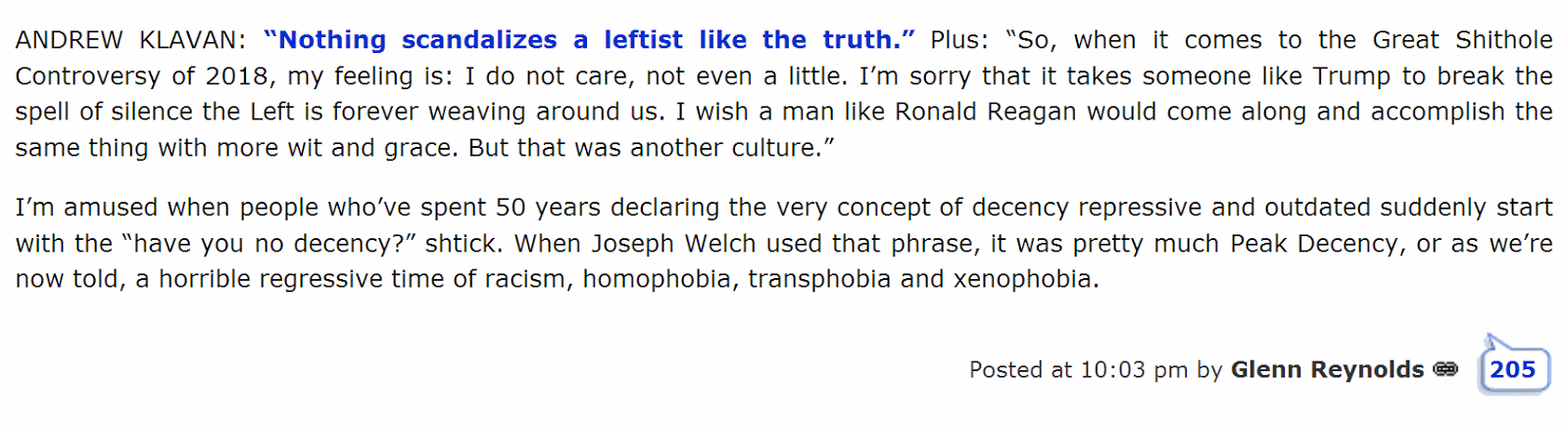

Update, 1/17/18: More commentary, this from Dennis Prager:
As a rule, a president of the United States should not label countries, let alone continents, "s---holes." I don't know what word the president actually used, but had he used the word "dysfunctional" instead of "s---hole," that actually might have been a service to the people of many of these countries. I have been to 20 African countries. Corruption is Africa's greatest single problem. That's why those who truly care about Africans, many of whom are terrific people, need to honestly describe the moral state of many or most African countries. What benefit is it to honest, hardworking Africans or Latin Americans or others to deny the endemic corruption of these societies?
As Guatemalan columnist Claudia Nunez wrote on Trump in the Guatemalan newspaper Siglio 21: "The epithets he uses to describe certain groups are unfortunate and exemplify the decadence of the current political scene. But he has also said things that are true, for example, that it is we citizens of migration countries who have accommodated ourselves to the need to export people, as we have calmly allowed excessive levels of corruption to grow for decades."
Direct Instruction
It works--but it requires a lot of preparation on the part of the teacher. Excellent preparation makes for excellent instruction (which makes teaching look easy)--but it's so much easier to put kids in groups and pretend that they're going to learn the material as well as they would have if they had been presented with excellent instruction. That, I believe, is why so many teachers turn their backs on a proven pedagogical style:
The findings of this meta-analysis reinforce the conclusions of earlier meta-analyses and reviews of the literature regarding DI. Yet, despite the very large body of research supporting its effectiveness, DI has not been widely embraced or implemented. In part this avoidance of DI may be fueled by the current popularity of constructivism and misconceptions of the theory that underlies DI. As explained in the first part of this article, DI shares with constructivism the important basic understanding that students interpret and make sense of information with which they are presented. The difference lies in the nature of the information given to students, with DI theorists stressing the importance of very carefully choosing and structuring examples so they are as clear and unambiguous as possible. Without such clarity students will waste valuable time and, even worse, potentially reach faulty conclusions that harm future progress and learning.If you don't support Direct Instruction, you're clearly a racist.
Many current curriculum recommendations, such as those included within the Common Core, promote student-led and inquiry-based approaches with substantial ambiguity in instructional practices. The strong pattern of results presented in this article, appearing across all subject matters, student populations, settings, and age levels, should, at the least, imply a need for serious examination and reconsideration of these recommendations (see also Engelmann, 2014a; Morgan, Farkas, & Maczuga, 2015; Zhang, 2016). It is clear that students make sense of and interpret the information that they are given—but their learning is enhanced only when the information presented is explicit, logically organized, and clearly sequenced. To do anything less shirks the responsibility of effective instruction.
Another reason that DI may not be widely used involves a belief that teachers will not like it or that it stifles teachers’ ability to bring their own personalities to their teaching. Yet, as described in earlier sections, proper implementation of DI does not disguise or erase a teacher’s unique style. In fact, the carefully tested presentations in the programs free teachers from worries about the wording of their examples or the order in which they present ideas and allow them to focus more fully on their students’ responses and ensure their understanding. Recall that effect sizes associated with teachers’ perceptions of the program reached as high as 1.04 in our analyses. Fears that teachers will not enjoy the programs or not be pleased with their results do not appear to be supported by the evidence.
Lipsey et al. (2012) have suggested that effect sizes based on performance gaps among demographic groups could be a useful benchmark in evaluating the potential impact of an intervention. Using data from the National Assessment of Education Progress, they calculated performance gaps in reading and math and found that the difference between more and less privileged groups corresponds to effect sizes ranging from 0.45 to 1.04 (Lipsey et al., 2012; p. 30; see also Bloom, Hill, Black, & Lipsey, 2008). These values are quite similar to the effects found in our analysis. In other words, the effects reported in this analysis, and calculated from 50 years of data on DI, indicate that exposure to DI could substantially reduce current achievement disparities between sociodemographic groups (boldface mine--Darren). Moreover, as noted above, at least for the academic subjects, greater exposure would be expected to result in even larger effects. There is little indication that the effects would be expected to decline markedly after intervention ceased; the positive effects are long-term.
I Think We're In A Contest In Our Society, The Goal Of Which Is To Say The Stupidest Thing And Get People To Pretend They Believe It.
While still a drip, drip, drip compared to what rains from the humanities, leftie professors at universities are jockeying to try to get math, science, and engineering fields into the "white supremacy" game:
Two points about the above quote.
First, this is the second time in a week I've read the term "portmanteau". Is that becoming "a thing"? Is jamming words together the new "in" thing, like putting capital letters in the middle of a word (e.g., iPhone, AirLand Battle Doctrine) or putting "e" at the beginning of a word in technical circles?
Second, 5. There it is, a number. 5. Is it a white number? Is it a black number? Is it an Asian number? Is it a Hispanic number? Whose interests does it serve? I'm a white man; would it mean something different if an American Indian woman had typed that number?
Just because you say something stupid, that doesn't mean I have to take it (or you) seriously.
Three British professors recently claimed that statistical analyses have been weaponized to “serve white racial interests” within academia and beyond.
Led by David Gillborn, a professor at the University of Birmingham, the professors argue that math serves white interests because it can “frequently encode racist perspectives beneath the facade of supposed quantitative objectivity.”
“Contrary to popular belief, and the assertions of many quantitative researchers, numbers are neither objective nor color-blind,” Gillborn and his team assert in their article for the journal Race, Ethnicity, and Education.
To address the racism numbers reinforce, the professors advocate for the adoption of “QuantCrit”—a portmanteau for “quantitative analysis” and “critical race theory.” Quantcrit, they say, has five key tenets, including that “numbers are not neutral.”
Numbers are not neutral because “quantitative data is often gathered and analyzed in ways that reflect the interests, assumptions, and perceptions of White elites,” they contend, adding that even so-called objective analysis fails to take the pervasiveness of racism into account...
“Numbers are social constructs and likely to embody the dominant (racist) assumptions that shape contemporary society,” they write. As a consequence, they assert that “in many cases, numbers speak for White racial interests.”
Two points about the above quote.
First, this is the second time in a week I've read the term "portmanteau". Is that becoming "a thing"? Is jamming words together the new "in" thing, like putting capital letters in the middle of a word (e.g., iPhone, AirLand Battle Doctrine) or putting "e" at the beginning of a word in technical circles?
Second, 5. There it is, a number. 5. Is it a white number? Is it a black number? Is it an Asian number? Is it a Hispanic number? Whose interests does it serve? I'm a white man; would it mean something different if an American Indian woman had typed that number?
Just because you say something stupid, that doesn't mean I have to take it (or you) seriously.
What Kind Of Feminist Am I?
I've long said that I'm a feminist of the Camille Paglia mold, believing that women have the same legal rights as men because they have agency, that they shouldn't be or act like victims, that they share responsibility for how they are treated in society, that they're entitled to no more and no less than they earn. That seems pretty fair to me.
It seems I'm also a Margaret Atwood-style feminist:
It seems I'm also a Margaret Atwood-style feminist:
My fundamental position is that women are human beings, with the full range of saintly and demonic behaviours this entails, including criminal ones. They're not angels, incapable of wrongdoing. If they were, we wouldn't need a legal system.She seems perfectly reasonable to me.
Nor do I believe that women are children, incapable of agency or of making moral decisions. If they were, we're back to the 19th century, and women should not own property, have credit cards, have access to higher education, control their own reproduction or vote. There are powerful groups in North America pushing this agenda, but they are not usually considered feminists.
Furthermore, I believe that in order to have civil and human rights for women there have to be civil and human rights, period, including the right to fundamental justice, just as for women to have the vote, there has to be a vote...
Thursday, January 11, 2018
No Means No!
Or does no mean no unless even higher leftie ideals are at stake?
Tolerance is no longer about tolerating; now it is about engaging in the issue at hand. For example, you're now considered an intolerant transphobe for refusing to make out with a transgender person.If a man assaulted a woman that way, he'd be rightly attacked--not made the victim, as Willoughby has been.
Ginuwine found this out first hand.
The R&B singer, appearing on the U.K. reality show "Big Brother," is being slammed as a transphobe for refusing to kiss his male-to-female transgender co-star India Willoughby on live TV.
When discussing dating, Willoughby complained that Ginuwine would date women but not him, claiming he really is a woman. When Ginuwine conceded that he would not date Willoughby if he knew he were trans, things escalated.
"I'm a woman, right," said Willoughby. "Forget about any 't's, or anything in front of it. So, on that score, you would date me, wouldn't you?"
"Not if you told me you was trans," replied Ginuwine.
"No, no, I'm not telling you I'm trans," Willoughby insisted. "I'm a woman."
"A woman? Yeah," answered the "Pony" singer.
This, for some reason, promoted Willoughby to grab Ginuwine's neck and lean in for a kiss. Ginuwine appeared to be extremely uncomfortable at this moment and quickly pulled away.
Ginuwine's rejection of the advances came with backlash; he's now being accused of transphobia.
You know how the saying goes, "No means no — unless a transgender person is making the advances, then you better comply or you'll be labeled a transphobic bigot."
Wednesday, January 10, 2018
The Tolerant Left
Leftists are very tolerant people--just ask them!--except when it comes to views with which they disagree. And people with whom they disagree (usually conservatives) are, in lefties' minds, clearly intolerant, giving lefties the opportunity to announce that they "won't tolerate intolerance". It's a very convenient circular argument, constantly reinforcing itself as well as the leftie's smugness and sense of superiority.
That smugness and superiority--heck, even their claim of being tolerant--is all an illusion, as this Instapundit post demonstrates:

That smugness and superiority--heck, even their claim of being tolerant--is all an illusion, as this Instapundit post demonstrates:

How The Other Half Thinks
My favorite "math author" is Sherman Stein. I have a couple of his books, both of which I recommend. The first one I read is called Strength In Numbers, and the second is How The Other Half Thinks. I met Stein one time at his home, and also went to a book signing he did once. A retired math professor, he was exceedingly able not only to talk about math, but also to explain it to people for whom math does not come easily.
How The Other Half Thinks is a book that, in a clear and interesting way, explains mathematical thought processes to "words people". I had a reverse "How The Other Half Thinks moment" today.
In my pre-calculus class we are beginning trigonometry, and today we discussed (among other things) the topic of coterminal angles. If it's been awhile since you studied angles, an example of coterminal angles would be a 30 degree angle and a 390 degree angle--angles that are a revolution (or multiple revolutions) apart, but both have the same sine, the same cosine, the same tangent, etc. One girl was having a difficult time with the concept, and then the lightbulb seemed to go on. "So, in words, they're kind of like synonyms?"
That's one of the awesome-est non-math explanations of a math concept I've ever heard!
How The Other Half Thinks is a book that, in a clear and interesting way, explains mathematical thought processes to "words people". I had a reverse "How The Other Half Thinks moment" today.
In my pre-calculus class we are beginning trigonometry, and today we discussed (among other things) the topic of coterminal angles. If it's been awhile since you studied angles, an example of coterminal angles would be a 30 degree angle and a 390 degree angle--angles that are a revolution (or multiple revolutions) apart, but both have the same sine, the same cosine, the same tangent, etc. One girl was having a difficult time with the concept, and then the lightbulb seemed to go on. "So, in words, they're kind of like synonyms?"
That's one of the awesome-est non-math explanations of a math concept I've ever heard!
Tuesday, January 09, 2018
Making It Look Easy
So many people think teaching is easy. It's not. But good teachers make it look easy.
I have a student teacher this year. She is in 2 "lower level" classes with another teacher and a relatively "upper level" class with me, and the three of us share a common prep period. She transitioned into teaching the two other classes, but only started actually teaching my class today. Her planning was exceptional, her content knowledge impressive.
When I have a student teacher, I don't just leave. How can I observe, evaluate, and coach, if I'm not there? Sure, eventually I'll leave the class, even all period, but it won't be all period every day. So today, our students' first day of the new semester, she taught while I sat in the back of class.
She's going to be an awesome teacher. I can just tell, she's going to be great at this. But as I sat in the back of the class, I noticed a couple things that she can improve on. Common rookie things.
There is so much more to teaching than just content knowledge. You have to know how to convey that content knowledge to others who don't have your background knowledge and extensive education. You have to convey the content in an understandable, neat, legible manner. You have to interact with the students, not just lecture to or at them. And it's usually better to have some prior planning rather than just try to wing it--counting on your own vast content knowledge and abilities to gloss over an obvious lack of preparation.
For those of you who are not teachers, have you ever had someone try to explain something to you, perhaps at a meeting? Or how about tech support people on the phone? Or presenters? Have you ever seen someone who probably knows their stuff but explains it to you poorly? That person might have plenty of knowledge but is not a good teacher.
And don't even get me started on people who read their PowerPoint slides (yes, I know teachers do that, too, sometimes)!
So as I sat in that back of class during that one class period today, I saw a teacher with tremendous potential. She's already not bad, but she can be so much better.
Good teachers make teaching look easy (just as experts in any field make their work look easy). But it's not. It is a craft that must be learned, practiced, and honed.
I have a student teacher this year. She is in 2 "lower level" classes with another teacher and a relatively "upper level" class with me, and the three of us share a common prep period. She transitioned into teaching the two other classes, but only started actually teaching my class today. Her planning was exceptional, her content knowledge impressive.
When I have a student teacher, I don't just leave. How can I observe, evaluate, and coach, if I'm not there? Sure, eventually I'll leave the class, even all period, but it won't be all period every day. So today, our students' first day of the new semester, she taught while I sat in the back of class.
She's going to be an awesome teacher. I can just tell, she's going to be great at this. But as I sat in the back of the class, I noticed a couple things that she can improve on. Common rookie things.
There is so much more to teaching than just content knowledge. You have to know how to convey that content knowledge to others who don't have your background knowledge and extensive education. You have to convey the content in an understandable, neat, legible manner. You have to interact with the students, not just lecture to or at them. And it's usually better to have some prior planning rather than just try to wing it--counting on your own vast content knowledge and abilities to gloss over an obvious lack of preparation.
For those of you who are not teachers, have you ever had someone try to explain something to you, perhaps at a meeting? Or how about tech support people on the phone? Or presenters? Have you ever seen someone who probably knows their stuff but explains it to you poorly? That person might have plenty of knowledge but is not a good teacher.
And don't even get me started on people who read their PowerPoint slides (yes, I know teachers do that, too, sometimes)!
So as I sat in that back of class during that one class period today, I saw a teacher with tremendous potential. She's already not bad, but she can be so much better.
Good teachers make teaching look easy (just as experts in any field make their work look easy). But it's not. It is a craft that must be learned, practiced, and honed.
Improvement
In the summer of 2010 I started a dieting and exercise regimen that resulted in my losing almost 25 pounds in 4 months. The exercise part of that regimen included a walk after work each day and 20 minutes on my elliptical trainer each morning.
Eventually I set an arbitrary goal of 200 calories burned in that 20 minute run--who doesn't like nice, round numbers?! After awhile I got to where I was burning 220-228 calories each morning. No, that isn't much, but it's better than not burning them. And the improvement in cardiovascular health was significant.
After 4 years I'd pretty much gained all that weight back, and now it's all back and then some. I haven't resumed the dieting or the afternoon walks, but when school started in August I started back on the elliptical trainer each morning. The first week of school I did 12 minutes a morning, the next week 13 minutes, etc., until I made it back to 20 minutes, and then I stayed at 20 minutes per morning. And, with the exception of only a handful of days last semester, I was on that elliptical trainer every "work morning". Being older and weighing more, though, I didn't get back to that magic 200 calories in 20 minutes.
Until today.
Maybe it was having 2+ weeks off, I don't know, but at the end of the workout this morning the meter read 211 calories. So I'm still not back up to where I was, but for the first time this school year I passed that psychological barrier of 200.
Improvement.
Eventually I set an arbitrary goal of 200 calories burned in that 20 minute run--who doesn't like nice, round numbers?! After awhile I got to where I was burning 220-228 calories each morning. No, that isn't much, but it's better than not burning them. And the improvement in cardiovascular health was significant.
After 4 years I'd pretty much gained all that weight back, and now it's all back and then some. I haven't resumed the dieting or the afternoon walks, but when school started in August I started back on the elliptical trainer each morning. The first week of school I did 12 minutes a morning, the next week 13 minutes, etc., until I made it back to 20 minutes, and then I stayed at 20 minutes per morning. And, with the exception of only a handful of days last semester, I was on that elliptical trainer every "work morning". Being older and weighing more, though, I didn't get back to that magic 200 calories in 20 minutes.
Until today.
Maybe it was having 2+ weeks off, I don't know, but at the end of the workout this morning the meter read 211 calories. So I'm still not back up to where I was, but for the first time this school year I passed that psychological barrier of 200.
Improvement.
Monday, January 08, 2018
Supreme Court Rulings
If we're honest, most of us would probably admit that we treat the Supreme Court like referees in a football game--wise and unbiased when they rule the way we like, and completely wrong if not crazy when they rule the other way. I admit to respecting the Court, and I even accept their "bad" decisions as the law of the land, even when I think they're grossly mistaken (e.g., Obamacare, Kelo, Roe v. Wade, etc.).
There are many people in this country, including a sitting senator from Colorado who should know better, disparaging the Attorney General for having the audacity to state that he will enforce federal law in this country, including marijuana laws. You many not agree with the law--I wouldn't be too disappointed if Congress and the president legalized marijuana--but the Attorney General isn't the right target for such an outcry. In fact, the author of this piece at Reason suggests that the Supreme Court deserves some of the opprobrium:
So how do we fix this?
There are many people in this country, including a sitting senator from Colorado who should know better, disparaging the Attorney General for having the audacity to state that he will enforce federal law in this country, including marijuana laws. You many not agree with the law--I wouldn't be too disappointed if Congress and the president legalized marijuana--but the Attorney General isn't the right target for such an outcry. In fact, the author of this piece at Reason suggests that the Supreme Court deserves some of the opprobrium:
What gives the federal government the authority to target legal state pot? The answer is not the Constitution. This federal power grab is the product of two awful Supreme Court precedents.Sometimes, the law is an ass. But it's still the law.
In 1942 the federal government brought sanctions against an Ohio farmer named Roscoe Filburn. His crime? He grew twice the amount of wheat that he was permitted to grow under the terms of the Agricultural Adjustment Act of 1938. That sweeping federal law, ostensibly passed as part of Congress's power to regulate interstate commerce, sought to raise agricultural prices by limiting the supply of crops.
Filburn defended himself from the feds by pointing out that his extra wheat never once entered the stream of interstate commerce. In fact, he noted, that extra wheat never even left his Ohio farm. He used it to feed his livestock and to make flour for use in his family's kitchen.
But the Supreme Court ruled against him on Commerce Clause grounds anyway. Filburn's extra wheat may not have crossed state lines, the Court conceded in Wickard v. Filburn, but it still had a "substantial economic effect" on the interstate wheat market. As a result, Congress had every right to regulate Filburn and other farmers in this manner.
Six decades later, in the case of Gonzales v. Raich (2005), the Supreme Court applied and extended the Filburn precedent by upholding the federal ban on marijuana, even as applied to plants that were cultivated and consumed by patients for their own doctor-prescribed use in states where medical cannabis was perfectly legal. "The [Controlled Substances Act] is a valid exercise of federal power," declared the majority opinion of Justice John Paul Stevens, "even as applied to the troubling facts of this case."
Writing in dissent, Justice Clarence Thomas spelled out the disastrous impact of the Wickard/Raich doctrine in plain English: "By holding that Congress may regulate activity that is neither interstate nor commerce under the Interstate Commerce Clause, the Court abandons any attempt to enforce the Constitution's limits on federal power."
So how do we fix this?
Sunday, January 07, 2018
Good-bye, Boomer
We got Boomer as a shelter dog; given his approximate age at that time, I always considered January 1st to be his birthday. So a few days ago he turned 13.
While his age was showing, he seemed in great health, especially for a dog of his age. Today, though, he started having seizures. By late afternoon he didn't know who I was, he didn't understand his surroundings, he didn't understand basic commands or the rules of the house (e.g., don't go in there); later this evening, I don't think he could even see. The seizure tonight didn't stop, so a friend and I rushed him to a vet hospital. Even though they understood what was going on, they gave me a few options.
As he lie on the table I made the decision, staying with him until he was at last calm, and in the land of infinite squirrels and treats and walkies.
He's at rest, and not hurting. I'm the one hurting now. Except for the first month or two, I haven't lived in this house without him. It's emptier tonight.
While his age was showing, he seemed in great health, especially for a dog of his age. Today, though, he started having seizures. By late afternoon he didn't know who I was, he didn't understand his surroundings, he didn't understand basic commands or the rules of the house (e.g., don't go in there); later this evening, I don't think he could even see. The seizure tonight didn't stop, so a friend and I rushed him to a vet hospital. Even though they understood what was going on, they gave me a few options.
As he lie on the table I made the decision, staying with him until he was at last calm, and in the land of infinite squirrels and treats and walkies.
He's at rest, and not hurting. I'm the one hurting now. Except for the first month or two, I haven't lived in this house without him. It's emptier tonight.
Friday, January 05, 2018
Diversity Training
Two recent stories at Campus Reform shed some light on what should be obvious about mandatory diversity training: it doesn't work, either in education or in business.
Let's tackle education first. Yes, I admit I'm really stretching here, using one data point from which to extrapolate to an entire population. But if you can find a study showing that certain programs "work", then please mention them in the comments.
Let's tackle education first. Yes, I admit I'm really stretching here, using one data point from which to extrapolate to an entire population. But if you can find a study showing that certain programs "work", then please mention them in the comments.
A professor at East Carolina University recently discovered that the diversity course she teaches isn’t actually “effective” in changing students’ racial or gender biases.Perhaps part of the reason for that is explained by the Harvard Business Review in its article about diversity in the workplace:
Dr. Michele Stacey, who teaches criminal justice at ECU, assessed the efficacy of the school’s diversity course by surveying 288 criminal justice students’ attitudes towards women and minorities both before and after taking the course, publishing her findings in the latest issue of the Journal of Criminal Justice Education.
Race, Gender, and Special Populations in the Criminal Justice System is a three-credit course that is required for the ECU major and minor in criminal justice. Aimed at educating students about the challenges of minorities in the criminal justice system, the course covers a variety of topics, including Native Americans and African Americans.
But while the course is also offered in the spirit of helping to reduce student’s bias towards these groups, Stacey discovered something interesting.
After assessing the bias of students before and after the course—using prompts such as “a woman should worry less about their rights and more about becoming good wives and mothers” and “if blacks would only try harder they could be just as well off as whites”—Stacey found that the course hadn’t altered students’ attitudes towards race or gender.
Only their attitudes towards homosexuality had changed, she found.
“The results of the t-test indicate that the only significant change over time in the scales was in attitudes toward homosexuality generally,” Stacey reports. “This would suggest that the course has no effect on [attitudes towards women], symbolic racism, or attitudes toward gays/lesbians specifically.”
“Overall, the results of the current study suggest that diversity courses do not have a significant impact on attitudes toward racial and gender minorities among criminal justice students,” she concludes.
Administrators across the country are folding to student demands for more diversity, but a recent study out of Harvard suggests that mandatory diversity trainings are actually making schools less diverse, not more.That doesn't surprise me at all. In general, people don't like being called racists (or most other -ist, for that matter), and let's be blunt, that's what happens in so-called diversity trainings. I recall the 3 hours I spent in "unconscious bias" training, only to learn 2 years later that the test used to find such bias is deeply flawed. As I stated at the latter link, "I've already identified why it (the implicit bias test) became the darling--because it told leftists exactly what they wanted to hear."
A survey in the current edition of the Harvard Business Review based on over three decades’ worth of data from more than 800 U.S. businesses shows that most diversity programs aren’t actually increasing diversity. In fact, the data suggest that diversity programs like the ones seen all over America’s campuses are having exactly the opposite effect.
The study’s authors, sociology professors Frank Dobbin of Harvard and Alexandra Kalev of Tel Aviv University, tracked the effect of diversity trainings on the actual growth of minority populations in businesses over a five-year period, but found that “after instituting required training for managers, companies saw no improvement in the proportion of white women, black men, and Hispanics in management, and the share of black women actually decreased by 9 percent, on average, while the ranks of Asian-American men and women shrank by 4 percent to 5 percent.”
The reason, the Review argues, is that managers, business executives, and employees in general are less likely to agree with a position if it is presented to them under mandatory circumstances. Indeed, the Review is not alone in its thinking, citing three other studies supporting the claim that compulsory diversity trainings are met with “resistance and anger” and that “many participants actually report more animosity toward other groups afterwards.”
Thursday, January 04, 2018
Oh, The Inhumanity Of It All
I call B.S. on this story, as I'm assured that all the good socialist business owners in Canada are happy to pay employees more, offer them great benefits, and subsidize national health care via crazy-high taxes:
Employees who work at Tim Hortons locations in Canada owned by the co-founders’ children will reportedly see their benefits reduced along with paid breaks over the country’s $2.40 increase to minimum wage.I guess the laws of economics still operate north of the border.
The Toronto Star reported Wednesday that employees at some of the Canadian-based coffee chain’s stores received a letter about the policy changes.
The letter from Jeri Horton-Joyce and Ron Joyce Jr. reportedly informed the employees that they will need to pay for a portion of their dental and health benefits.
"These changes are due to the increase of wages to $14.00 minimum wage on January 1, 2018, then $15.00 per hour on January 1, 2019, as well as the lack of assistance and financial help from our Head Office and from the Government," the letter read...
Tim Hortons issued a statement to CBC News, stating, "Almost all of our restaurants in Canada are independently owned and operated by small business Owners who are responsible for handling all employment matters, including all policies for benefits and wages, for their restaurants."
A Cloudy Day on College Campuses?
Marijuana is illegal in the United States but "legal" in a few states, including California. I think it's perhaps more correct to say that possession and use of certain amounts of pot are not against state law in California; California is still (nominally?) part of the Union, and hence pot is illegal in California.
Having said that, how about pot on California's campuses?
Update, 1/5/18: In related news, the following screenshot comes from Instapundit:

This is exactly correct. It is not up to the states to determine which federal laws they will comply with, and neither should a sitting senator expect the President and his administration not to enforce federal laws--when making sure the laws are faithfully enforced is the very definition of the President's responsibilities. If the senator doesn't like the law, he should exercise his Article I prerogative and change the law.
Cory Gardner is clearly an idiot.
Having said that, how about pot on California's campuses?
Anybody 21 or older can legally buy recreational marijuana in California starting Monday. But they still can’t take it to school.Odd that California gets federal monies but doesn't feel obligated to follow federal law.
Officials from the Sacramento-area campuses of Los Rios Community College District, the University of California and California State University say school policies barring marijuana on campus and at school-sponsored events have not changed since California voters passed Proposition 64, which legalized recreational cannabis.
The colleges all have similar drug policies saying possession or use of illegal drugs, including marijuana, on campus could result in disciplinary action ranging from treatment programs to dismissal.
“While marijuana is regulated differently in California, the federal government still considers it illegal,” said Anita Fitzhugh, a spokeswoman for California State University, Sacramento. “As a state entity receiving federal funding, Sacramento State is obligated to follow federal laws regarding drugs.”
Update, 1/5/18: In related news, the following screenshot comes from Instapundit:

This is exactly correct. It is not up to the states to determine which federal laws they will comply with, and neither should a sitting senator expect the President and his administration not to enforce federal laws--when making sure the laws are faithfully enforced is the very definition of the President's responsibilities. If the senator doesn't like the law, he should exercise his Article I prerogative and change the law.
Cory Gardner is clearly an idiot.
If You Support the Constitution, How Can You Support This?
The last time Democratic states seceded from the Union, it didn't go well for them:
Supporters of California’s newly-minted status as a sanctuary state for illegal aliens have predictably hailed the move as an act of compassion. However, it’s time to call this what it truly is: an act of rebellion by a state against the authority of the federal government that will endanger the lives of law enforcement officials and California residents.I honestly don't see how people can support this except as a cynical political move.
SB 54, the landmark bill which was passed last October and went into effect this month, bans local officials from asking about a person’s immigration status. Golden State law enforcement will only be allowed to cooperate with federal authorities regarding individuals who have been convicted of committing a specified list of felonies or misdemeanors.
Wednesday, January 03, 2018
Grandpa's Candy Closet
I'm one of the lucky ones. Most of my life, my grandparents were just a short drive away. All of them. I had all my grandparents while I was growing up, and didn't lose the first one until I was in my 30s. I got to see them frequently.
Both my grandmothers adored me. Grandma always called me "number one grandson" and it certainly wasn't because I was her oldest, because I wasn't the oldest. Nana made all my birthday cakes for me when I was young and had an "I love my cadet" bumper sticker on her car when I got older. My grandfathers were from that "greatest generation" and weren't very expressive with their emotions. I loved them, and I know they loved me, but what I really would like to know is if I impressed them. If I were to judge only from the big picture taken on graduation day at West Point, I know that at least I made them proud.
Nana and grandpa bought their house in late 1961. They were the first owners. I'm the second owner; grandpa died over 20 years ago now, and when nana's Alzheimer's got bad enough, I bought the house. I've lived here a dozen years last summer.
Gawd, I loved coming here as a child. I adored my grandparents, and they deserved it. But there was always a special treat at nana and grandpa's. See, the coat closet at the front of the hallway has a low shelf in it, and that's where grandpa kept his candy. Grandpa had a sweet tooth, and I inherited it from him. My dad's wife didn't allow us to eat candy at home when I was growing up, but we could always have a treat at nana and grandpa's. We'd raid that closet! And even when I got older, whenever I visited I'd make at least one trip to the "candy closet". Even after grandpa was gone, nana kept candy there. Most often she kept a large bag of Skittles in there, the better to refill the candy dish that was always on the coffee table in the front room.
That candy shelf in the front closet now holds light bulbs, furniture polish, air freshener, stuff like that. I keep a small amount of candy in a container in a kitchen cupboard. I got some candy for Christmas, and a few times tonight I went into the kitchen to get a piece. That's where I've kept the candy since moving in here over 12 years ago, in that kitchen cupboard.
So why, on my last trip to get a piece of candy, did I head to grandpa's candy closet?
Both my grandmothers adored me. Grandma always called me "number one grandson" and it certainly wasn't because I was her oldest, because I wasn't the oldest. Nana made all my birthday cakes for me when I was young and had an "I love my cadet" bumper sticker on her car when I got older. My grandfathers were from that "greatest generation" and weren't very expressive with their emotions. I loved them, and I know they loved me, but what I really would like to know is if I impressed them. If I were to judge only from the big picture taken on graduation day at West Point, I know that at least I made them proud.
Nana and grandpa bought their house in late 1961. They were the first owners. I'm the second owner; grandpa died over 20 years ago now, and when nana's Alzheimer's got bad enough, I bought the house. I've lived here a dozen years last summer.
Gawd, I loved coming here as a child. I adored my grandparents, and they deserved it. But there was always a special treat at nana and grandpa's. See, the coat closet at the front of the hallway has a low shelf in it, and that's where grandpa kept his candy. Grandpa had a sweet tooth, and I inherited it from him. My dad's wife didn't allow us to eat candy at home when I was growing up, but we could always have a treat at nana and grandpa's. We'd raid that closet! And even when I got older, whenever I visited I'd make at least one trip to the "candy closet". Even after grandpa was gone, nana kept candy there. Most often she kept a large bag of Skittles in there, the better to refill the candy dish that was always on the coffee table in the front room.
That candy shelf in the front closet now holds light bulbs, furniture polish, air freshener, stuff like that. I keep a small amount of candy in a container in a kitchen cupboard. I got some candy for Christmas, and a few times tonight I went into the kitchen to get a piece. That's where I've kept the candy since moving in here over 12 years ago, in that kitchen cupboard.
So why, on my last trip to get a piece of candy, did I head to grandpa's candy closet?
Monday, January 01, 2018
How Does This Shoe Feel?
This author is considering what it's like when the shoe is on the other foot--only because the shoe is now on the other foot:
Until recently, George Ciccariello-Maher was an anonymous political science professor at Drexel University in Philadelphia. However, of late a white-hot mob has threatened him -- and his child -- so gravely that he is now teaching via a video feed. This week he announced he's resigning out of concern for his family's safety: "My situation has become unsustainable," he explained on his Facebook account.
Surely Ciccariello-Maher said something racist or, to use the dominant term of art, white supremacist? No -- the people issuing a fountain of death threats against him all year have been from the right.
A year ago, Ciccariello-Maher tweeted a wry joke -- "All I Want for Christmas is White Genocide" -- in the vein of the self-critical "That's so white" meme now popular among Blue Americans. He said the tweet was a "satirical jab at a certain paranoid racist fantasy and that white genocide does not exist."
A few months later, he tweeted that it made him want to vomit watching someone give up their first-class airline seat to a soldier. In October, he tweeted that "Trumpism" and the "narrative of white victimization" were to blame for the lethal mass shooting in Las Vegas.
In other words, the professor's critics now feel "injured," by someone they thus deem unfit for human society.
Their forcing someone into hiding for just writing some stuff is unforgivable. But it should make us think about when the shoe is on the other foot.As is often said on Instapundit, the Left isn't going to like having to play by the new rules they themselves have created. The author realizes this:
However, there is no conception of justice or truth that makes it somehow pardonable "collateral damage" when the left behaves this way -- which it does too frequently. The behaviors are mirror-image parallels...We'll see if anyone on the left heeds the author's words. I will not be holding my breath.
I suspect that many horrified by the Drexel professor's situation will stick to a basic idea that the left is right and the right is wrong, and thus tarring and feathering the right-winger is progress while tarring and feathering the left-winger is injustice.
Yet just as many will -- one hopes -- understand that this view is too short-sighted, privileging the gut over the brain.
Subscribe to:
Posts (Atom)