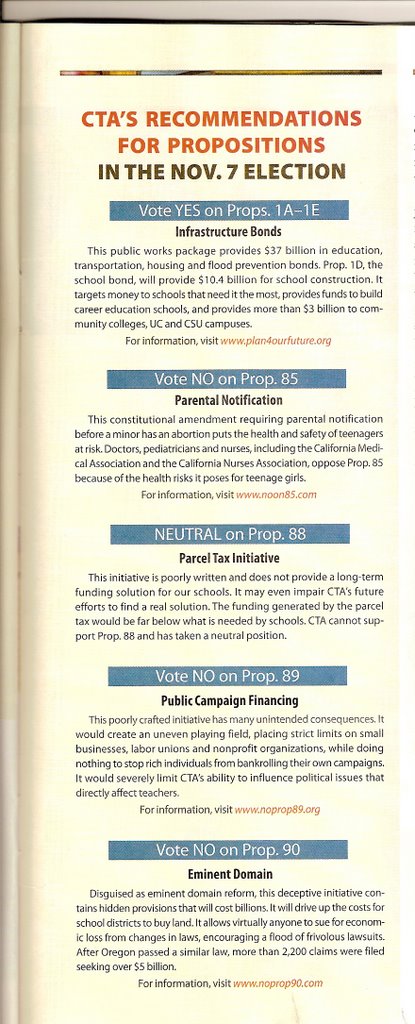
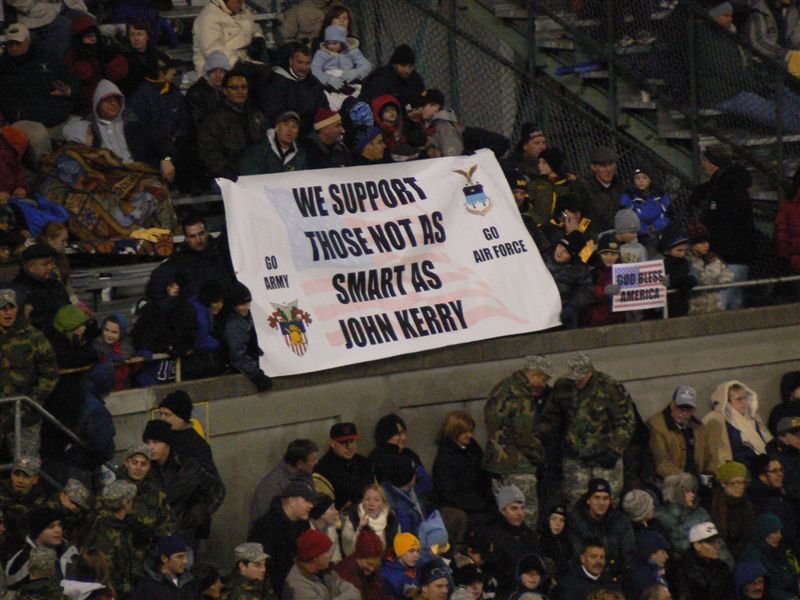
From page 13 of the October 2006 edition:
Librarian Chris Enterline hardly looks like a freedom fighter as she neatly stacks the shelves. But when her district tried to ban books about gays and lesbians in the the school library where she worked, she got fighting mad and went to bat for students' First Amendment rights.
Let's look at the First Amendment, shall we? It reads:
Congress shall make no law respecting an establishment of religion, or prohibiting the free exercise thereof; or abridging the freedom of speech, or of the press; or the right of the people peaceably to assemble, and to petition the government for a redress of grievances.
Exactly what student First Amendment rights were violated? Assuming we're talking about free speech here, who was forbidden to speak by not having a book in the library? "Banning" books may not be a
smart thing to do, and it may not even always be the
right thing to do, but it's certainly legal.
So the CTA uses this situation to show, somehow, that it is a strong supporter of the First Amendment. How ironic, then, that in the same issue of California Educator, pg 10 finds these words:
So-called Academic Bill of Rights legislation that's being considered in several states would stifle debate and silence controversial views on college campuses, according to Kathy Sproles, president of NEA's National Council for Higher Education.
Really? Let's see what an "
academic bill of rights" would include:
1. All faculty shall be hired, fired, promoted and granted tenure on the basis of their competence and appropriate knowledge in the field of their expertise and, in the humanities, the social sciences, and the arts, with a view toward fostering a plurality of methodologies and perspectives. No faculty shall be hired or fired or denied promotion or tenure on the basis of his or her political or religious beliefs.
2. No faculty member will be excluded from tenure, search and hiring committees on the basis of their political or religious beliefs.
3. Students will be graded solely on the basis of their reasoned answers and appropriate knowledge of the subjects and disciplines they study, not on the basis of their political or religious beliefs.
4. Curricula and reading lists in the humanities and social sciences should reflect the uncertainty and unsettled character of all human knowledge in these areas by providing students with dissenting sources and viewpoints where appropriate. While teachers are and should be free to pursue their own findings and perspectives in presenting their views, they should consider and make their students aware of other viewpoints. Academic disciplines should welcome a diversity of approaches to unsettled questions.
5. Exposing students to the spectrum of significant scholarly viewpoints on the subjects examined in their courses is a major responsibility of faculty. Faculty will not use their courses for the purpose of political, ideological, religious or anti-religious indoctrination.
6. Selection of speakers, allocation of funds for speakers programs and other student activities will observe the principles of academic freedom and promote intellectual pluralism.
7. An environment conducive to the civil exchange of ideas being an essential component of a free university, the obstruction of invited campus speakers, destruction of campus literature or other effort to obstruct this exchange will not be tolerated.
8. Knowledge advances when individual scholars are left free to reach their own conclusions about which methods, facts, and theories have been validated by research. Academic institutions and professional societies formed to advance knowledge within an area of research, maintain the integrity of the research process, and organize the professional lives of related researchers serve as indispensable venues within which scholars circulate research findings and debate their interpretation. To perform these functions adequately, academic institutions and professional societies should maintain a posture of organizational neutrality with respect to the substantive disagreements that divide researchers on questions within, or outside, their fields of inquiry.
So the CTA, Defender of the First Amendment, is against these principles.
And remember, these two stories I've quoted from are in the same issue of the magazine. If I've said it once, I've said it a thousand times: hypocrisy is a strong point of the Left.